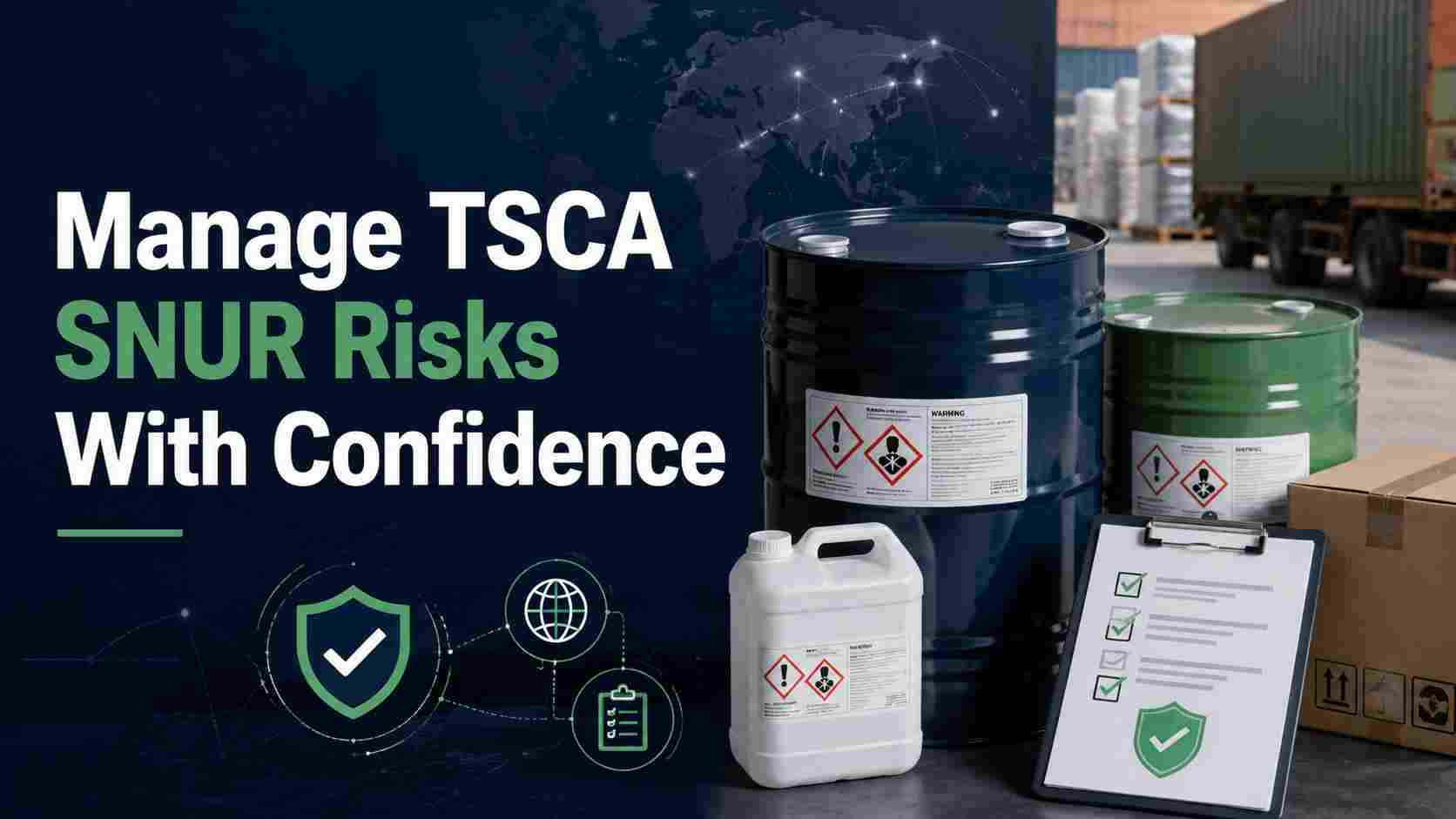
What Is TSCA Section 5(a)(2) SNUR Compliance?
Under the Toxic Substances Control Act, TSCA Section 5(a)(2) allows the U.S. Environmental Protection Agency to determine that a use of a chemical substance is a “significant new use.” Once EPA makes that determination through a Significant New Use Rule, companies must notify EPA before starting that activity. EPA states that a Significant New Use Notice must be submitted at least 90 days before manufacturing, including importing, or processing a chemical substance for that significant new use.
In simple terms, a SNUR does not always mean a chemical substance is banned. Instead, it means that a specific use, condition, exposure scenario, processing activity, or release pathway may require EPA review before the company can proceed.
For businesses, this makes TSCA SNUR compliance a market-access issue. It can affect product launches, imports, supplier approvals, formulation changes, customer applications, technical documentation, and compliance certifications.
Why TSCA SNUR Compliance Matters for Businesses
A SNUR can create risk when a company does not have clear visibility into the substances it manufactures, imports, processes, or uses in products and materials. The issue is not only whether a chemical substance exists in the supply chain. The key question is whether the company’s actual activity matches a use that EPA has designated as significant.
This is especially important for companies with complex supply chains. A TSCA SNUR obligation may be linked to a substance in a raw material, mixture, additive, coating, adhesive, component, intermediate, or imported chemical.
For a potential client, the practical concern is clear:
- Can we import this substance or product into the United States?
- Are we using a chemical substance in a way that requires EPA notification?
- Do we have enough supplier data to prove our compliance decision?
- Could a formulation, supplier, or customer-use change create a new SNUR obligation?
- Are we keeping the right records if EPA, customs, or customers ask for evidence?
Does TSCA SNUR Compliance Apply to Your Company?
TSCA SNUR compliance may apply if your company manufactures, imports, processes, distributes, or uses chemical substances covered by a Significant New Use Rule.
|
Company Type |
Why SNUR Compliance Matters |
|
Manufacturers |
A new chemical use, production change, exposure condition, or processing method may trigger a SNUN obligation. |
|
Importers |
TSCA defines manufacture to include import, so importers must screen substances and applicable uses before shipment. |
|
Processors |
Formulation, blending, repackaging, incorporation, or downstream use may create a significant new use. |
|
Product compliance teams |
SNUR risk may be hidden inside materials, components, mixtures, coatings, or supplier formulations. |
|
Procurement teams |
Supplier declarations must be detailed enough to support substance-level and use-condition screening. |
|
Regulatory affairs teams |
Proposed and final SNURs must be monitored to identify new compliance obligations. |
|
Supply chain teams |
Supplier changes, new applications, and alternative sourcing can change the compliance status of a product or material. |
Latest TSCA SNUR Updates for 2026
EPA continued issuing proposed and final SNUR actions in 2026. This shows that companies should treat TSCA SNUR compliance as an active monitoring area, not a one-time check.
|
Date |
EPA Action |
Business Relevance |
|
December 18, 2024 |
EPA finalized updates to new chemicals regulations under TSCA, including updates affecting information requirements for new chemical notices such as PMNs and SNUNs. |
Companies should expect stronger expectations for complete, known, or reasonably ascertainable information in new chemical submissions. |
|
April 24, 2026 |
EPA issued proposed SNURs for certain chemical substances in batch 26-2. The proposed rules require notification at least 90 days before manufacturing, importing, or processing for a designated significant new use. |
Businesses should review whether covered substances, suppliers, or future uses may be affected. |
|
May 21, 2026 |
EPA extended the comment period for the proposed batch 26-2 SNURs until July 10, 2026. |
Affected companies had additional time to assess potential operational and supply chain impacts. |
|
May 22, 2026 |
EPA issued final SNURs for certain chemical substances in batch 25-1.5e, effective July 21, 2026. |
Companies need to review affected substances before manufacturing, importing, or processing for covered uses. |
|
June 5, 2026 |
EPA proposed SNURs for batch 25-3.5e, with comments due July 6, 2026. |
Companies should check whether proposed significant new uses affect product development, sourcing, or customer applications. |
|
June 10, 2026 |
EPA proposed SNURs for batch 26-1. The proposal explains that EPA considers factors such as manufacturing or processing volume and changes in human or environmental exposure. |
Businesses should evaluate whether planned uses could change exposure, release, or operational conditions. |
What Is a Significant New Use Notice?
A Significant New Use Notice, or SNUN, is the notice a company must submit to EPA before starting a designated significant new use. EPA states that a manufacturer or processor wishing to engage in a designated significant new use must submit a SNUN at least 90 days before engaging in that use.
EPA uses the SNUN review process to evaluate the intended use before it begins. This may include reviewing the substance identity, intended use, exposure conditions, worker protection measures, environmental release, disposal, and available health or environmental data.
EPA also explains that SNUN submissions are made electronically using the e-PMN form, and the submitter should identify the CFR citation of the SNUR and the specific significant new use being submitted.
What Activities Can Trigger a SNUR Obligation?
A SNUR obligation may be triggered when the actual business activity does not match the conditions allowed under the relevant rule. 40 CFR Part 721 is the main regulatory location for Significant New Use Rules and includes provisions covering notice requirements, import and export provisions, recordkeeping, workplace protection, hazard communication, industrial and commercial activity, disposal, and release to water.
|
Potential Trigger |
Practical Example |
|
Manufacturing a covered substance |
A company begins producing a substance for a use covered by a SNUR. |
|
Importing a covered substance |
An importer brings a chemical substance or mixture into the U.S. for a designated significant new use. |
|
Processing a substance differently |
A company blends, formulates, repackages, or incorporates a substance into a new application. |
|
Changing customer applications |
A downstream use changes from one application to another that may increase exposure or release. |
|
Changing workplace controls |
Required personal protective equipment, engineering controls, or hazard communication measures are not followed. |
|
Changing environmental release |
Wastewater, disposal, or environmental release conditions differ from those allowed under the rule. |
|
Using a different supplier |
A new supplier provides a similar material, but the substance identity or use conditions are different. |
|
Reformulating a product |
A replacement substance or additive creates a new compliance review need. |
|
Scaling production |
Higher volumes may affect exposure, release, or regulatory assessment. |
|
Exporting a covered substance |
TSCA export notification obligations may also need to be reviewed depending on the substance and rule. |
Why Importers Face Higher SNUR Risk
Importers have a specific risk because TSCA defines manufacture to include import. EPA explains that the TSCA SNUN requirement applies to import of new uses of chemicals, meaning importers cannot treat SNUR compliance as only a domestic manufacturing issue.
This creates a practical challenge. Importers often rely on overseas suppliers for chemical identity, formulation details, use descriptions, and compliance declarations. If the supplier information is incomplete, the importer may not be able to confirm whether the substance is covered by a SNUR or whether the intended use requires EPA notification.
For importers, the question is not only:
“Is this chemical allowed?”
The more important question is:
“Is this chemical allowed for our specific import, processing, use, exposure condition, and downstream application without a SNUN?”
What Happens If a Company Misses a SNUR Obligation?
Missing a TSCA SNUR obligation can create business, operational, and regulatory risk. A company may face delayed product launches, blocked shipments, customer compliance concerns, incomplete import certification, enforcement exposure, or the need to stop a planned use until EPA review is complete.
SNUR compliance is therefore not only a legal task. It is a business continuity issue. If a company cannot confirm whether a substance or intended use is covered, it may create uncertainty for purchasing, production, import planning, customer delivery, and market access.
Step-by-Step TSCA SNUR Applicability Review
A practical SNUR review should answer five core questions.
|
Step |
Question to Answer |
Why It Matters |
|
1. Identify the substance |
What chemical substances are present in the material, mixture, product, or process? |
SNUR screening starts with accurate substance identity. |
|
2. Check regulatory status |
Is the substance listed under a SNUR in 40 CFR Part 721 or affected by a recent EPA action? |
A listed substance may require use-condition review. |
|
3. Review actual use |
How is the substance manufactured, imported, processed, used, distributed, disposed of, or released? |
SNUR obligations depend on the specific use and conditions. |
|
4. Compare against the rule |
Does the intended activity match a designated significant new use? |
If yes, a SNUN may be required before the activity begins. |
|
5. Document the decision |
Can the company prove how it reached its compliance conclusion? |
Evidence is critical for audits, customers, import controls, and internal governance. |
Practical Compliance Checklist
Companies should build a repeatable TSCA SNUR compliance process instead of relying on one-time manual checks.
|
Compliance Area |
Practical Action |
|
Substance inventory |
Maintain a structured list of substances used in products, materials, mixtures, and processes. |
|
Supplier declarations |
Collect chemical identity, concentration, use, and compliance information from suppliers. |
|
SNUR screening |
Screen substances against 40 CFR Part 721 and recent EPA proposed and final SNUR activity. |
|
Use-condition review |
Compare actual and intended activities against the significant new use definition. |
|
Import review |
Confirm whether imported substances, mixtures, or applicable materials create TSCA obligations. |
|
Workplace controls |
Check whether PPE, engineering controls, hazard communication, or SDS statements are required. |
|
Environmental release |
Review disposal, water release, and other environmental exposure conditions. |
|
Change control |
Reassess SNUR status when suppliers, formulations, materials, uses, or customers change. |
|
SNUN decision |
Determine whether a SNUN is required at least 90 days before the activity starts. |
|
Recordkeeping |
Store evidence, declarations, applicability decisions, and internal approvals in a traceable system. |
What Documentation Should Companies Keep?
A defensible TSCA SNUR compliance file should include:
- Substance identity and CAS information where available
- Supplier identity and supplier declarations
- Product, material, mixture, or component mapping
- Applicable 40 CFR Part 721 references
- SNUR screening results
- Intended use and actual use description
- Manufacturing, importing, processing, distribution, disposal, and release information
- Workplace protection and hazard communication information
- Import applicability review
- Export notification review where relevant
- SNUN decision record
- Internal compliance approval before activity begins
- Supplier, formulation, and customer-use change history
- Supporting communications and technical evidence
The purpose of this documentation is to show that the company made a controlled, evidence-based decision before manufacturing, importing, or processing.
Common TSCA SNUR Compliance Mistakes
1. Treating SNURs as a simple chemical list check
SNUR compliance is not only about whether a substance appears on a list. The real question is whether the company’s activity is a designated significant new use.
2. Assuming “TSCA compliant” supplier statements are enough
A general supplier statement may not confirm substance identity, exact use conditions, exposure controls, release pathways, or whether a SNUN is required.
3. Forgetting that import counts as manufacture
Importers are directly affected because TSCA defines manufacture to include import. This makes SNUR screening important before shipment, customs certification, and U.S. market entry.
4. Missing supplier or formulation changes
A supplier change, alternative material, replacement additive, or new formulation can change the substance profile and trigger a new review.
5. Not connecting procurement, R&D, and compliance teams
SNUR risk can appear during product development, supplier onboarding, sourcing changes, or customer-specific applications. If teams work separately, the compliance risk may be identified too late.
6. Relying on spreadsheets and emails
Manual tracking makes it harder to prove what was checked, when it was checked, who approved it, and whether supplier information was complete.
FAQ: TSCA SNUR Compliance
What is a SNUR?
A Significant New Use Rule is an EPA rule that identifies a specific use of a chemical substance as a significant new use under TSCA Section 5(a)(2). Before starting that activity, companies may need to submit a SNUN to EPA.
What is a SNUN?
A Significant New Use Notice is the notification submitted to EPA before manufacturing, importing, or processing a chemical substance for a designated significant new use. EPA states that the SNUN must be submitted at least 90 days before the activity begins.
Does a SNUR ban a chemical substance?
Not necessarily. A SNUR usually creates a pre-manufacture, pre-import, or pre-processing notification requirement for a specific significant new use. EPA then reviews the intended activity before it begins.
Are importers affected?
Yes. TSCA defines manufacture to include import, and EPA confirms that the SNUN requirement applies to imports involving new uses of chemicals.
Where are SNUR requirements found?
SNUR requirements are primarily found in 40 CFR Part 721, which covers Significant New Uses of Chemical Substances.
When should a company review SNUR applicability?
Companies should review SNUR applicability before manufacturing, importing, processing, reformulating, changing suppliers, changing customer applications, or starting a new use of a chemical substance.
How ComplyMarket Product Compliance Software Can Help
TSCA SNUR compliance becomes difficult when substance information, supplier declarations, product data, and regulatory decisions are scattered across emails, spreadsheets, PDFs, and disconnected systems.
ComplyMarket helps companies create a more structured and traceable product compliance process. ComplyMarket’s material compliance software is designed to collect compliance and sustainability information from suppliers, manage chemicals and risk, and support product and material compliance across the supply chain.
For TSCA SNUR compliance, ComplyMarket can help companies:
- Centralize supplier, material, product, component, and substance data
- Collect supplier declarations through structured compliance workflows
- Map substances to products, components, materials, and suppliers
- Identify which products or materials may require TSCA screening
- Support regulatory change monitoring and compliance evidence tracking
- Maintain documentation for internal reviews, customer requests, and audits
- Improve traceability when suppliers, formulations, or product uses change
- Reduce reliance on manual spreadsheets and scattered email follow-ups
- Support risk-based decisions before importing, manufacturing, or processing begins
ComplyMarket also describes material compliance management as controlling composition data across materials, parts, assemblies, finished goods, and packaging so companies can meet market-access rules, supplier communication duties, technical documentation requirements, and customer declaration requests.
For a company managing TSCA SNUR obligations, this means ComplyMarket can help answer critical business questions faster:
- Which suppliers provide substances or materials that need TSCA review?
- Which products may contain substances subject to a SNUR?
- Do we have enough supplier data to assess use conditions?
- Can we prove why a SNUN was or was not required?
- Are supplier, formulation, or application changes being reviewed before they create compliance risk?
- Is our compliance evidence organized, traceable, and ready for review?

Comments
Leave a comment or ask a question
No comments yet.