PPWR Packaging Data Management Guide for 2026
Packaging compliance is becoming a data management challenge.
Under the EU Packaging and Packaging Waste Regulation, known as the PPWR, companies need much more than a general description of their packaging. They need structured, traceable, and up-to-date data on packaging materials, components, weights, recycled content, recyclability, labels, supplier declarations, EPR registrations, deposit-return systems, reuse and refill systems, and technical documentation.
Regulation (EU) 2025/40 on packaging and packaging waste entered into force on 11 February 2025 and generally applies from 12 August 2026. The European Commission guidance confirms these dates and explains that the PPWR applies to packaging and packaging waste across the EU.
The PPWR sets sustainability and labelling requirements for packaging throughout its life cycle, including production, use, and waste management. It aims to prevent unnecessary packaging and promote reuse, refill, and recycling.
For companies, this means packaging data can no longer be managed only in scattered spreadsheets, supplier emails, artwork folders, or local EPR portals. Packaging data must be connected to products, suppliers, countries, compliance obligations, technical evidence, and reporting outputs.
The attached packaging compliance workshop identifies packaging data as a critical requirement across PPWR topics, including substance restrictions, recyclability, recycled content, labelling, technical documentation, minimization, reuse/refill, producer registration, annual reporting, deposit-return systems, online platform obligations, and formal non-compliance risks. It also lists the data producers must provide, such as producer identification, packaging quantities, EPR scheme details, recycling and recovery data, deposit-return data, packaging composition, reusable packaging data, and changes to information.
For manufacturers, importers, brand owners, retailers, online sellers, and packaging suppliers, the key message is clear: packaging compliance depends on reliable data.
Why Packaging Data Management Matters Under PPWR
Packaging data management matters because almost every PPWR obligation depends on data.
A company cannot assess recyclability without material and component data. It cannot report EPR obligations without weight and country data. It cannot support recycled content claims without supplier evidence. It cannot prove minimization without dimensions, weights, and technical justification. It cannot manage labelling without material composition and claim evidence.
Packaging data supports:
- PPWR applicability assessment
- Product-to-packaging mapping
- Material composition analysis
- Substance restriction checks
- Recyclability assessment
- Recycled content verification
- Packaging labelling decisions
- Technical documentation
- EU Declaration of Conformity records
- EPR registration and reporting
- Deposit-return system participation
- Reusable packaging tracking
- Empty space and minimization calculations
- Online marketplace compliance checks
- Country-specific packaging obligations
- Audit readiness
The workshop explains that producers must provide accurate and reliable data to authorities so Member States can fulfil their reporting obligations, and it identifies greater data granularity for producers unless they place less than 10 tonnes of packaging on the market.
In practical terms, packaging data management is no longer an administrative task. It is the backbone of packaging compliance.
Who Needs Packaging Data Management?
Packaging data management affects any business that places packaging or packaged products on the EU market.
Businesses that need packaging data management
|
Business Type |
Why Packaging Data Matters |
|
Manufacturers |
Need to prove packaging compliance and prepare technical documentation |
|
Importers |
Need evidence for packaging imported into the EU |
|
Brand owners |
Often control packaging design, claims, suppliers, and labels |
|
Retailers |
May manage private-label packaging, service packaging, and in-store packaging |
|
Online sellers |
Need EPR registration data and marketplace evidence |
|
Marketplaces |
May need to verify seller EPR compliance |
|
Packaging suppliers |
Need to provide material, weight, recycled content, and compliance data |
|
Distributors |
May need to verify packaging information before selling |
|
Compliance teams |
Need evidence for audits, authorities, and internal reviews |
|
Sustainability teams |
Need data for circularity, recycled content, reuse, and reporting |
|
Procurement teams |
Need supplier declarations and change notifications |
|
Finance teams |
Need EPR fee, deposit, and packaging cost data |
ComplyMarket’s packaging compliance information describes packaging compliance as applying to companies that manufacture, import, distribute, fill, label, or sell packaged products, with obligations that can cover materials, labelling, recycling, waste management, documentation, registration, reporting, and EPR.
This means packaging data should be managed across departments, not only by one team.
Packaging Data Is Not One Data Point
Many companies begin packaging compliance by asking one simple question: “What material is this packaging made from?”
That question is important, but it is not enough.
PPWR readiness requires packaging data at several levels:
|
Data Level |
Example |
|
Product level |
Which product or SKU uses this packaging? |
|
Packaging unit level |
Is it sales, grouped, transport, e-commerce, reusable, or service packaging? |
|
Component level |
Bottle, cap, label, adhesive, coating, sleeve, insert, tray, film |
|
Material level |
Plastic, paper, cardboard, glass, metal, wood, composite |
|
Weight level |
Weight per component and total packaging weight |
|
Country level |
Where is the packaging placed on the market? |
|
Supplier level |
Which supplier provides the packaging or material? |
|
Evidence level |
Which declaration, test report, certificate, or assessment supports the data? |
|
Obligation level |
Which PPWR, EPR, DRS, labelling, or documentation requirement applies? |
|
Version level |
Which packaging design version is currently used? |
Without these connections, companies may have data but still lack compliance control.
A packaging item may look simple, but it may contain several regulated data points. For example, a plastic bottle may need data on resin type, recycled content percentage, bottle weight, closure material, label material, adhesive compatibility, recyclability grade, DRS status, country-specific EPR registration, and supplier evidence.
Core Packaging Data Fields Companies Should Collect
A practical packaging data system should start with a core set of fields. These fields should be standardized across product lines, suppliers, and markets.
Core packaging data checklist
|
Data Category |
Examples |
|
Product identification |
Product name, SKU, product family, brand, product category |
|
Packaging identification |
Packaging code, packaging version, packaging supplier, packaging type |
|
Packaging level |
Sales, grouped, transport, e-commerce, service, reusable, refill |
|
Market information |
Country placed on market, legal entity, sales channel |
|
Material composition |
Plastic, paper, cardboard, glass, metal, wood, composite, other |
|
Component breakdown |
Bottle, cap, label, sleeve, adhesive, coating, closure, tray, box, insert |
|
Weight data |
Component weight, total packaging weight, material weight by component |
|
Dimensions |
Product dimensions, packaging dimensions, empty space data |
|
Supplier data |
Supplier name, supplier contact, production site, declaration date |
|
Substance data |
Heavy metals, PFAS, Substances of Concern, MOAH/MOSH where relevant |
|
Recyclability data |
Design-for-recycling status, recyclability grade, at-scale evidence |
|
Recycled content |
Percentage, source, post-consumer recycled content evidence |
|
Compostability |
Compostability status, standard, certificate, claim evidence |
|
Reuse/refill |
Reuse system, rotations, collection points, refill instructions |
|
Labelling |
Sorting label, material label, QR code, DRS label, environmental claims |
|
EPR data |
Registration number, PRO, appointed representative, reporting status |
|
DRS data |
Deposit-bearing packaging, deposit value, collection data |
|
Technical documentation |
Technical file, test reports, Declaration of Conformity |
|
Change history |
Supplier changes, material changes, artwork changes, data updates |
The workshop’s producer information section lists many of these categories, including producer identification, national identification codes, packaging quantities, EPR scheme details, recycling and recovery data, deposit-return data, environmental reporting, packaging composition, reusable packaging data, and changes to information.
Packaging Data for Material Composition
Material composition is one of the most important data areas because it supports recyclability, labelling, EPR reporting, recycled content assessment, technical documentation, and packaging restrictions.
Companies should identify every material and component in the packaging.
Material composition data fields
|
Data Field |
Why It Matters |
|
Main material |
Determines packaging category and EPR reporting |
|
Component materials |
Labels, closures, inks, coatings, and adhesives can affect compliance |
|
Composite packaging breakdown |
Multi-material packaging may need weight breakdown |
|
Material weight |
Needed for reporting and fee calculation |
|
Plastic type |
Important for recycled content, recyclability, and DRS |
|
Paper/cardboard type |
Important for recycling stream and coating assessment |
|
Metal type |
Ferrous metal and aluminium may be reported separately |
|
Glass type |
Supports EPR and DRS data |
|
Wood packaging |
May trigger separate material reporting |
|
Coatings and barriers |
Can affect recycling and substance assessment |
The workshop explains that composite packaging and other multi-material formats must be calculated per material, except where a material is insignificant and below 5% by mass. It also states that material breakdown for composite packaging should be reported by weight where the material is more than 5% of total mass.
This means companies need component-level weight data, not only a general packaging description.
Packaging Data for Substance Compliance
Packaging materials can contain regulated substances through inks, coatings, adhesives, additives, recycled inputs, pigments, and barriers.
The workshop identifies substance-related packaging requirements such as the combined concentration limit for lead, cadmium, mercury and hexavalent chromium, PFAS phase-out direction, minimization of Substances of Concern, microplastics considerations, and MOAH/MOSH restrictions.
Substance data companies should collect
|
Data Field |
Purpose |
|
Heavy metals declaration |
Supports Pb, Cd, Hg and Cr(VI) compliance |
|
PFAS declaration |
Important for coated, grease-resistant, barrier, and specialty packaging |
|
Substances of Concern information |
Supports recycling and safety assessment |
|
Microplastics relevance |
Supports future substance mapping and compliance reviews |
|
MOAH/MOSH data |
Relevant for paper, board, inks, and food-contact packaging |
|
Food-contact evidence |
Needed for sensitive packaging applications |
|
Supplier test reports |
Supports audit-ready evidence |
|
Material Safety Data Sheet where relevant |
Supports substance review |
|
Change notification |
Ensures data is updated if formulations change |
Product substance compliance data should not be assumed to cover packaging. Packaging often has different suppliers and materials than the product itself.
Packaging Data for Recyclability
Recyclability under PPWR depends on whether packaging is designed for recycling, collected, sorted, able to produce quality secondary materials, and recycled at scale.
The EUR-Lex summary confirms that all packaging must be recyclable, designed for material recycling, and able to be collected, sorted, and recycled at scale when it becomes waste. It also notes that recyclability performance grades apply from 2030 and recycled-at-scale requirements apply from 2035.
The workshop explains that producers must keep technical documentation to prove that packaging meets recycling criteria, including design for recycling and at-scale recyclability. It also identifies recyclability performance grades from A to E and notes that EPR fees can be modulated based on the awarded recyclability grade.
Recyclability data fields
|
Data Field |
Why It Matters |
|
Packaging category |
Determines relevant recyclability assessment criteria |
|
Design-for-recycling status |
Required for 2030 readiness |
|
Recyclability grade |
Supports compliance and possible EPR fee modulation |
|
Collection compatibility |
Shows whether packaging can enter separate collection |
|
Sorting compatibility |
Shows whether packaging can be correctly sorted |
|
Component compatibility |
Labels, adhesives, closures, and coatings may affect recyclability |
|
At-scale recyclability evidence |
Important from 2035 |
|
Test reports or third-party assessments |
Supports technical documentation |
|
Supplier recyclability declaration |
Supports data collection and evidence |
|
Redesign status |
Tracks packaging that needs improvement |
Recyclability data should be linked to packaging design versions. A change in adhesive, label, coating, color, closure, or sleeve can change the recyclability profile.
Packaging Data for Recycled Content
Plastic packaging may need recycled content data, especially for 2030 and 2040 targets.
The workshop identifies recycled content targets for plastic packaging, including 2030 targets for PET contact-sensitive packaging, other contact-sensitive plastic packaging, single-use plastic beverage bottles, and other plastic packaging. It also notes that by 31 December 2026, the EU is expected to define the methodology for calculating and verifying recycled content, and from 1 January 2029 manufacturers must follow the methodology.
Recycled content data fields
|
Data Field |
Why It Matters |
|
Plastic packaging category |
Determines the applicable target |
|
PET or non-PET status |
Important for contact-sensitive packaging |
|
Contact-sensitive status |
Affects target category |
|
Single-use beverage bottle status |
Has specific targets |
|
Recycled content percentage |
Core compliance data point |
|
Post-consumer recycled content evidence |
Supports PPWR requirements |
|
Supplier declaration |
Supports traceability |
|
Calculation method |
Needed for methodology compliance |
|
Verification evidence |
Supports audit readiness |
|
Exemption status |
Needed for medical, medicinal, IVD, or compostable plastic packaging where relevant |
Recycled content should be controlled as compliance data, not only a sustainability claim.
Packaging Data for Labelling and QR Codes
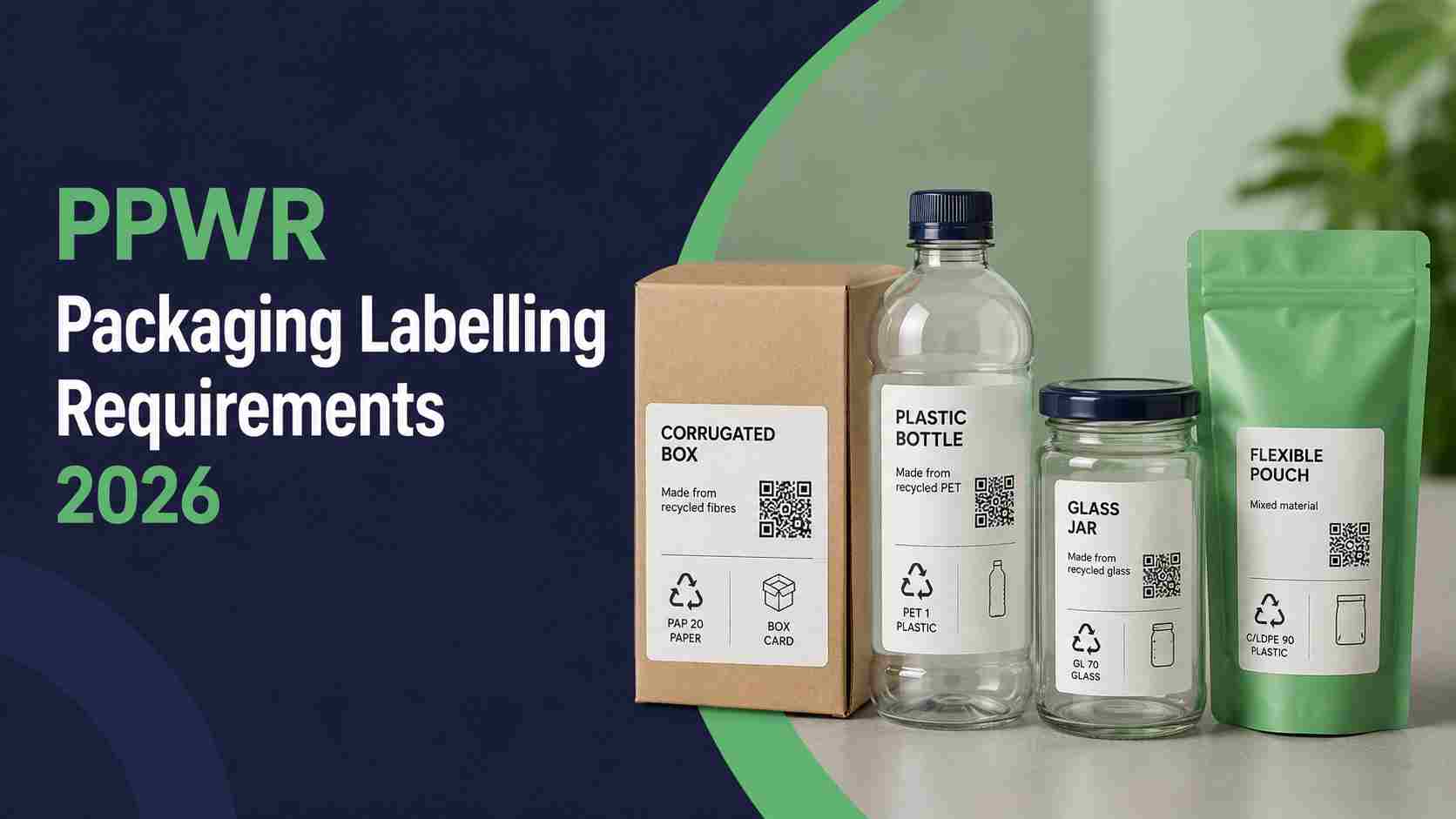
Packaging labelling under PPWR depends on data. Labels must match the actual packaging material, recycled content, reusability status, compostability status, DRS participation, and manufacturer information.
The workshop identifies labelling topics such as material composition labels, reusability information, recycled content labels, biobased plastic labels, deposit-return labels, waste collection labels, manufacturer information, harmonized labels, QR codes, and misleading label restrictions. It also states that labels and digital codes must be visible, clear, and permanent.
Labelling data fields
|
Data Field |
Why It Matters |
|
Material composition |
Supports sorting and material labels |
|
Packaging type |
Determines which label may apply |
|
Reusable packaging status |
Supports reuse labels and QR codes |
|
QR code destination |
Ensures digital information is controlled |
|
DRS participation |
Supports deposit-return labels |
|
Recycled content percentage |
Supports recycled content labels |
|
Biobased content data |
Supports biobased plastic labels where used |
|
Compostability status |
Supports compostability labels |
|
Manufacturer information |
Supports traceability and contact requirements |
|
Environmental claims |
Must be linked to evidence |
|
Artwork version |
Ensures labels match packaging version |
The workshop also identifies wrong or incomplete QR code or data carrier information as a formal non-compliance issue.
Companies should manage label data and artwork versions together. A correct technical assessment can still become a compliance risk if the wrong label is printed on the packaging.
Packaging Data for Technical Documentation
Technical documentation is the evidence file that proves packaging compliance.
The workshop identifies five core technical documentation areas: general description of the packaging, design and manufacturing details, list of relevant standards or specifications, evidence of recyclability assessments, and Declaration of Conformity. It also states that the Declaration of Conformity should be kept with the technical documentation for at least 10 years after the packaging is placed on the market.
Technical documentation data fields
|
Data Field |
Purpose |
|
Packaging description |
Explains what the packaging is and its intended use |
|
Packaging drawings |
Shows structure, components, sub-assemblies, and dimensions |
|
Material list |
Supports substance, recyclability, and reporting assessments |
|
Standards used |
Shows assessment methods and specifications |
|
Recyclability assessment |
Supports design-for-recycling and at-scale evidence |
|
Test reports |
Supports technical conclusions |
|
Supplier declarations |
Supports composition, substance, and recycled content data |
|
Environmental claim evidence |
Supports labels and marketing claims |
|
Declaration of Conformity |
Formal compliance statement |
|
Version history |
Shows changes over time |
|
Responsible person/team |
Supports governance and accountability |
Technical documentation should be connected to packaging data rather than stored separately in folders that are difficult to update and audit.
Packaging Data for EPR Registration and Reporting
Packaging EPR is one of the most data-heavy parts of packaging compliance.
The workshop explains that producers must register in each Member State where they make packaging available on the market for the first time and must not make packaging available there if they, or their appointed representatives where applicable, are not registered. It also states that producers or appointed representatives must report by 1 March each year for the previous calendar year.
EPR data fields
|
Data Field |
Why It Matters |
|
Producer legal entity |
Identifies responsible company |
|
Brand names |
Supports registration and market traceability |
|
Trade register number |
Supports legal identification |
|
Tax identification number |
Supports national register requirements |
|
Member State |
Determines registration and reporting obligation |
|
Registration number |
Needed for proof of compliance and marketplaces |
|
PRO details |
Supports collective EPR compliance |
|
Appointed representative |
Needed where required for cross-border obligations |
|
Packaging type |
Sales, grouped, transport, e-commerce, reusable |
|
Material type |
Plastic, glass, paper/cardboard, metal, wood, other |
|
Packaging weight |
Basis for reporting and fees |
|
Packaging quantity |
Units or tonnage placed on market |
|
Reporting period |
Supports annual reporting |
|
Marketplace self-certification |
Supports online sales compliance |
ComplyMarket’s EPR management information describes EPR as requiring regulatory intelligence, applicability control, data collection, reporting, evidence management, and jurisdiction-level management because EPR is not one single law but a combination of framework rules and stream-specific obligations.
This is why packaging EPR data should be managed continuously throughout the year, not collected only before the reporting deadline.
Packaging Data for Deposit and Return Systems
Deposit and Return Systems, known as DRS, create another layer of packaging data.
The workshop states that by 1 January 2029, Member States must ensure deposit and return systems are set up for single-use plastic beverage bottles up to 3 liters and single-use metal beverage containers up to 3 liters, with certain exemptions and collection-rate conditions. It also identifies DRS data needs, such as quantities of deposit-bearing packaging placed on the market and collected through the system.
DRS data fields
|
Data Field |
Why It Matters |
|
Deposit-bearing status |
Determines whether DRS applies |
|
Packaging material |
Plastic, metal, glass where applicable |
|
Beverage container volume |
Helps determine DRS scope |
|
Country DRS system |
DRS rules differ by market |
|
Deposit value |
Supports pricing and refund process |
|
Barcode or identifier |
Supports return process |
|
DRS label |
Supports consumer recognition |
|
Units placed on market |
Supports reporting |
|
Units collected |
Supports collection rate reporting |
|
Refund data |
Supports system operation |
|
Return point information |
Supports consumer access and reporting |
|
System operator details |
Supports compliance records |
DRS data often involves compliance, finance, sales, retail operations, and logistics teams. It should not be managed only as a label or packaging artwork issue.
Packaging Data for Reuse and Refill Systems
Reuse and refill requirements also depend on data. Companies need to know which packaging is reusable, where it circulates, how many trips or rotations it completes, and whether reuse targets are being met.
The workshop identifies reusable packaging data such as quantities of reusable packaging placed on the market, percentage of reusable packaging compared to total packaging placed on the market, tonnage of reusable packaging in circulation, and reuse rates by material and packaging type. It also explains that QR codes or digital data carriers may provide information on reuse systems, collection points, and tracking for calculating trips and rotations.
Reuse and refill data fields
|
Data Field |
Why It Matters |
|
Reusable packaging status |
Determines whether reuse obligations apply |
|
Reuse system type |
Closed-loop or open-loop |
|
System operator |
Supports responsibility and tracking |
|
Packaging units in circulation |
Supports reuse rate calculations |
|
Trips or rotations |
Measures real reuse performance |
|
Reconditioning records |
Shows packaging is cleaned, repaired, or restored |
|
Collection points |
Supports consumer and system participation |
|
Refill station data |
Supports refill obligations |
|
End-user information |
Shows hygiene and container-use rules |
|
QR code content |
Supports digital reuse information |
|
Reuse rate |
Supports target reporting |
|
Exemption status |
Needed where thresholds or exemptions apply |
A reuse claim without tracking data can become difficult to prove.
Packaging Data for Minimization and Empty Space
Packaging minimization and empty space rules require dimensions, weights, filler data, product measurements, and technical justification.
The workshop explains that packaging must be designed to use the fewest materials by weight and volume needed to protect and contain the product. It also states that grouped, transport, and e-commerce packaging cannot have more than 50% empty space, and that fillers such as paper cuttings, air cushions, bubble wrap, foam, wood wool, polystyrene, and similar materials count as empty space.
Minimization and empty space data fields
|
Data Field |
Why It Matters |
|
Product dimensions |
Needed to assess packaging fit |
|
Sales packaging dimensions |
Needed for e-commerce and transport packaging calculations |
|
Outer packaging dimensions |
Needed to calculate total volume |
|
Empty space ratio |
Supports compliance with empty space rule |
|
Filler type |
Fillers count as empty space |
|
Filler volume |
Needed for assessment |
|
Packaging weight |
Supports minimization and EPR data |
|
Product fragility data |
Supports protection justification |
|
Test results |
Supports why packaging cannot be reduced further |
|
Alternative designs reviewed |
Supports minimization evidence |
|
Reusable packaging function |
Multiple rotations may justify stronger packaging |
Packaging right-sizing should be connected to data, not judged only visually.
Packaging Data for Online Marketplace Compliance
Online platforms may request packaging EPR evidence and registration information.
The workshop states that online marketplaces should verify producer registration, obtain registration numbers, require self-certification that EPR obligations are complied with, facilitate compliance, cooperate with authorities, and prevent non-registered producers from selling on the platform. It also states that sellers should provide registration details, comply with EPR requirements, certify packaging compliance, and provide accurate and reliable data to authorities on quantities, types, and materials of packaging placed on the market.
Marketplace packaging data fields
|
Data Field |
Why It Matters |
|
Seller legal entity |
Identifies responsible seller |
|
Producer registration number |
Required for marketplace checks |
|
Member State registration |
Shows where the seller is registered |
|
Self-certification record |
Confirms EPR compliance statement |
|
Packaging material and weight |
Supports reporting and verification |
|
Product-to-country mapping |
Shows where products are sold |
|
PRO participation evidence |
Supports compliance proof |
|
Appointed representative details |
Needed where applicable |
|
Packaging compliance evidence |
Supports platform requests |
|
Reporting records |
Shows ongoing compliance |
For online sellers, packaging data is now part of sales continuity. Missing packaging data can affect product listings and market access.
Packaging Databases: What Producers May Need to Store
The workshop includes a comprehensive table of data producers or PROs must report and store in packaging databases. It covers producer identification, national identification codes, packaging placed on market, reusable packaging, separately collected waste, recycling and recovery data, deposit-return system data, composite packaging data, biodegradable waste data, exported waste, recycled materials in new products, loss rates, annual plastic carrier bag data, material-specific recycling, and recovery/disposal quantities.
Packaging database structure
|
Database Section |
Example Data |
|
Producer profile |
Legal entity, brands, contacts, national IDs |
|
Product mapping |
SKU, product family, market, sales channel |
|
Packaging inventory |
Packaging codes, versions, suppliers, packaging levels |
|
Material data |
Materials, components, weights, composite breakdown |
|
Evidence library |
Supplier declarations, test reports, certificates, assessments |
|
Technical documentation |
Technical files, standards, DoC, recyclability assessments |
|
EPR records |
Registration numbers, PROs, representatives, reporting status |
|
DRS records |
Deposit-bearing packaging, deposits, returns, collection rates |
|
Reuse/refill records |
Units in circulation, rotations, refill stations, collection points |
|
Labelling records |
Artwork, QR codes, sorting labels, claims, DRS labels |
|
Reporting outputs |
Country reports, annual submissions, audit history |
|
Change log |
Supplier changes, material changes, artwork changes, market changes |
A well-structured packaging database should connect data points rather than store them as isolated files.
Packaging Data Governance: Who Owns What?
Packaging data management fails when no one owns the data.
Because packaging data sits across departments, companies need a governance model that defines who creates, reviews, approves, updates, and uses each data field.
Packaging data governance model
|
Function |
Typical Responsibility |
|
Regulatory affairs |
Interprets requirements and defines compliance data needs |
|
Product compliance |
Maintains compliance evidence and technical documentation |
|
Packaging engineering |
Provides design, material, weight, and dimension data |
|
Procurement |
Collects supplier declarations and change notifications |
|
Sustainability |
Uses data for circularity, recycled content, reuse, and reporting |
|
Quality |
Reviews test reports, specifications, and supplier evidence |
|
Logistics |
Provides transport, grouped, and e-commerce packaging data |
|
E-commerce |
Provides marketplace and sales channel data |
|
Finance |
Uses data for EPR fees, deposit systems, and cost planning |
|
Legal |
Reviews claims, contracts, and responsibility allocation |
|
IT / data team |
Maintains systems, access rights, and integrations |
Each critical data field should have an owner, source, evidence type, update frequency, and approval status.
Supplier Data Collection: What to Request
Suppliers are often the source of packaging data. This includes packaging manufacturers, converters, raw material suppliers, label suppliers, closure suppliers, printing suppliers, and logistics providers.
The workshop states that suppliers of packaging or packaging materials should provide manufacturers with the information and documentation necessary to demonstrate compliance.
Supplier data request checklist
|
Supplier Data |
Why It Matters |
|
Packaging specification |
Defines the packaging item |
|
Material composition |
Supports labelling, recyclability, and EPR reporting |
|
Component weights |
Supports reporting and composite calculations |
|
Restricted substance declaration |
Supports heavy metals, PFAS, SoC, and chemical compliance |
|
Recycled content evidence |
Supports PPWR recycled content requirements |
|
Recyclability assessment |
Supports design-for-recycling evidence |
|
Compostability certificate |
Supports compostable packaging claims |
|
Food-contact declaration where relevant |
Supports sensitive packaging uses |
|
Technical drawings |
Supports technical documentation |
|
Test reports |
Supports performance and compliance assessments |
|
Certifications |
Supports verification where relevant |
|
Change notification commitment |
Ensures updates when materials or specifications change |
Supplier data should be linked to exact packaging versions. Generic supplier statements may not be enough if they do not identify the specific material, product, batch, or packaging code.
Packaging Data Quality: Common Problems
Packaging data problems often create compliance problems.
Common data quality issues
|
Problem |
Compliance Risk |
|
Missing packaging weights |
EPR reporting and fee calculations become inaccurate |
|
Outdated supplier declarations |
Technical documentation may not match current packaging |
|
No component breakdown |
Recyclability and composite packaging assessment becomes weak |
|
Unverified recycled content claims |
Claims and targets may not be defensible |
|
No product-to-country mapping |
EPR registration obligations may be missed |
|
Duplicate packaging records |
Teams may use different data for the same packaging |
|
No version control |
Old and new packaging specifications may be mixed |
|
Inconsistent material categories |
Country reports may be wrong |
|
Missing evidence files |
Data cannot be proven during audit |
|
Broken QR code records |
Digital information may become incomplete |
|
Spreadsheet-only workflows |
Scaling across markets becomes difficult |
A packaging data system should include validation rules, required fields, approval workflows, version control, and audit history.
Building an Audit-Ready Packaging Data Process
An audit-ready packaging data process should be structured, repeatable, and evidence-based.
Practical packaging data process
|
Step |
Action |
|
1 |
Create a packaging inventory |
|
2 |
Map packaging to products, suppliers, and countries |
|
3 |
Classify packaging by level and material |
|
4 |
Collect component weights and dimensions |
|
5 |
Request supplier declarations and evidence |
|
6 |
Assess substance, recyclability, recycled content, and labelling requirements |
|
7 |
Prepare technical documentation and Declaration of Conformity records |
|
8 |
Link EPR registration and reporting data |
|
9 |
Track DRS, reuse, refill, and empty space data where relevant |
|
10 |
Maintain change control and audit history |
This process should be built into product development, supplier onboarding, packaging changes, market launch approvals, annual reporting, and internal audits.
Packaging Data Readiness Roadmap
Companies can use the following roadmap to build PPWR-ready packaging data management.
Step 1: Build a complete packaging inventory
List all packaging used across products, suppliers, packaging levels, and markets.
Step 2: Create a packaging BoM
Break packaging down into components such as box, tray, label, sleeve, cap, closure, adhesive, coating, ink, film, filler, pallet, and transport packaging.
Step 3: Map packaging to products and countries
Connect each packaging item to SKUs, product families, brands, legal entities, and markets placed on.
Step 4: Standardize material categories
Use consistent material categories for plastic, paper, cardboard, glass, metal, wood, composite, biodegradable, compostable, and other materials.
Step 5: Collect weights and dimensions
Collect packaging weight by component and material, plus dimensions needed for minimization and empty space assessments.
Step 6: Collect supplier evidence
Request declarations, test reports, certifications, composition data, recycled content data, recyclability evidence, and change notifications.
Step 7: Connect data to obligations
Link packaging data to PPWR requirements, EPR registrations, DRS obligations, labelling rules, technical documentation, and marketplace checks.
Step 8: Control labels and claims
Connect packaging artwork, QR code content, environmental claims, and labels to evidence and approval workflows.
Step 9: Prepare reporting outputs
Build country-level reporting views for EPR, DRS, reusable packaging, plastic carrier bags, recycled content, and other obligations.
Step 10: Maintain data over time
Update packaging data when suppliers, materials, designs, labels, countries, volumes, or regulations change.
Packaging Data Management Checklist
|
Question |
Status |
|
Is every packaging item listed in a central inventory? |
To be checked |
|
Is each packaging item linked to products and countries? |
To be checked |
|
Is each packaging level identified? |
To be checked |
|
Are all components recorded? |
To be checked |
|
Is material composition documented? |
To be checked |
|
Are component weights available? |
To be checked |
|
Are packaging dimensions available? |
To be checked |
|
Are supplier declarations collected and current? |
To be checked |
|
Is substance compliance evidence available? |
To be checked |
|
Is recyclability evidence available? |
To be checked |
|
Is recycled content evidence available where relevant? |
To be checked |
|
Are labels and QR codes linked to evidence? |
To be checked |
|
Are EPR registration numbers stored by country? |
To be checked |
|
Are PRO and appointed representative records stored? |
To be checked |
|
Is DRS data tracked where relevant? |
To be checked |
|
Is reusable packaging data tracked? |
To be checked |
|
Are empty space calculations available where needed? |
To be checked |
|
Is technical documentation complete and version-controlled? |
To be checked |
|
Are reporting outputs audit-ready? |
To be checked |
|
Is there a change management process? |
To be checked |
This checklist can support supplier onboarding, product launch approvals, packaging redesign, annual EPR reporting, marketplace checks, and internal audits.
Common Packaging Data Mistakes to Avoid
Packaging data mistakes are often caused by fragmented ownership and manual processes.
Common mistakes
|
Mistake |
Why It Creates Risk |
|
Treating packaging data as an annual reporting task only |
Data should be managed continuously |
|
Not linking packaging to SKUs |
Compliance cannot be proven at product level |
|
Using estimated weights |
EPR reports and fees may be inaccurate |
|
Ignoring components |
Labels, closures, coatings, and adhesives can affect compliance |
|
Not tracking packaging versions |
Old evidence may not match new packaging |
|
Collecting supplier data without evidence |
Claims may not be defensible |
|
Managing data separately by country |
Duplicate and inconsistent records may appear |
|
Not tracking marketplace registration data |
Online sales may be affected |
|
Not linking labels to data |
Artwork may not match compliance evidence |
|
Failing to update after packaging changes |
Technical files and reports become outdated |
A strong packaging data management process should replace assumptions with structured records, evidence, ownership, and version control.
How ComplyMarket Supports Packaging Data Management
Packaging data management under PPWR requires a connected system for products, packaging, suppliers, markets, evidence, reporting, and documentation.
ComplyMarket’s packaging compliance service explains that typical packaging compliance documents include packaging specifications, supplier declarations, test reports, labelling records, registration evidence, and packaging reporting data. It also highlights that packaging requirements vary by country, language, reporting framework, and EPR system, making manual compliance difficult to manage at scale.
ComplyMarket’s packaging compliance management service describes packaging compliance as the process of identifying applicable packaging rules, linking those rules to each packaging item or packaged product, collecting the right data and supplier evidence, validating compliance status, and deciding where packaging can be placed on the market.
ComplyMarket can help companies manage packaging data by supporting:
- Packaging inventory and packaging BoM management
- Product-to-packaging and country mapping
- Supplier declaration and evidence collection
- Packaging material, component, weight, and dimension data management
- Substance compliance evidence tracking
- Recyclability and recycled content documentation
- Labelling, QR code, and artwork evidence control
- Technical documentation and Declaration of Conformity support
- EPR registration and reporting data preparation
- DRS data tracking for deposit-bearing packaging
- Reuse, refill, and rotation data management
- Marketplace registration evidence and self-certification support
- Version control for packaging, supplier, material, and artwork changes
- Audit-ready records for internal and external compliance reviews
- Digital Product Passport and circular economy data readiness
The attached workshop identifies ComplyMarket capabilities across product compliance management software, sustainability reporting software, material compliance software, packaging compliance, Extended Producer Responsibility services, Digital Product Passport, authorized representative services, and global market access.
For companies managing packaging compliance across multiple products, suppliers, and countries, the challenge is not only collecting packaging data. The real challenge is keeping that data accurate, connected, evidence-backed, and ready for reporting, audits, marketplace checks, and authority requests.
ComplyMarket helps companies move from scattered spreadsheets, supplier emails, and disconnected records to a structured, traceable, and scalable packaging compliance data process.


Comments
Leave a comment or ask a question
No comments yet.