🌍 A New Era for Packaging Labels in the EU
Packaging labels are about to become much more than small recycling symbols printed on boxes, bottles, pouches, cartons and e-commerce parcels. Under the EU Packaging and Packaging Waste Regulation, commonly known as the PPWR, packaging placed on the EU market is moving toward a harmonised labeling system designed to make waste sorting clearer for consumers and more predictable for businesses.
The purpose is simple but important: consumers should understand what the packaging is made of and where it belongs at the moment of disposal. Companies should also be able to reduce the patchwork of national waste sorting labels currently needed for the same packaging sold across the EU.
For manufacturers, importers, retailers, packaging suppliers, brand owners, this is not only an artwork update. It is a compliance change involving material data, supplier evidence, digital information, environmental claims and approval workflows.
🧭 What Is Changing?
The EU approach focuses on harmonised waste sorting information for packaging. Instead of relying mainly on local destination wording, such as “yellow bag,” “blue bin” or country-specific disposal instructions, the proposed system is based primarily on the material composition of the packaging.
Labels should help consumers identify whether packaging is:
- 📄 Paper
- 📦 Cardboard
- 🟡 Rigid or flexible plastic
- 🟢 Glass
- ⚙️ Metal
- 🟤 Wood or cork
- 🧵 Textile
- 🏺 Ceramic
- 🟫 Compostable packaging
- 🟣 Residual waste
- 🔴 Hazardous packaging
The core concept is packaging-to-bin matching.
Look at the label on the packaging → Find the matching label on the bin → Sort correctly.
♻️ Why Harmonised Packaging Labels Matter
The current packaging labeling landscape in Europe is fragmented. Different Member States, regions and municipalities use different symbols, colors, terminology and sorting instructions. A package sold in several EU countries may need different artwork versions simply because national labeling rules are not aligned.
For businesses, this fragmentation can create multiple packaging files, extra translation checks, higher printing costs, complex stock management and greater risk of incorrect labeling.
For consumers, inconsistent labels can reduce trust and lead to mistakes. If a familiar color or symbol means different things across countries, sorting becomes less intuitive. Incorrect sorting can contaminate recycling streams and reduce material quality.
📌 Key Labeling Requirements under the PPWR
The JRC technical proposal highlights several labeling elements that companies should monitor closely as the implementing rules develop.
|
Requirement Area |
What It Means for Packaging |
|
🧱 Material composition |
Packaging should indicate material composition through harmonised labels. |
|
🖼️ Pictograms |
Labels should be based mainly on pictograms so consumers can understand them quickly. |
|
🗣️ Minimal language |
Text should be limited, clear and easy to translate where required. |
|
🧑🦯 Accessibility |
Labels should be understandable for persons with disabilities. |
|
🧾 Online sales visibility |
Labeling information should be available before purchase, including online sales. |
|
📲 Digital data carriers |
QR codes or other digital tools may provide supplementary information. |
|
🗑️ Bin matching |
Packaging labels should correspond to labels on waste receptacles. |
|
🧩 Composite packaging |
Specific rules are expected for composite and multi-component packaging. |
|
🌱 Compostable packaging |
Labels must clearly communicate compostability and warn against disposal in nature. |
|
🇪🇺 National collection differences |
The system must consider differences in Member State collection systems. |
🧱 Material-Based Labels: The Core Principle
One of the most important changes is the move toward material-based labeling. The label should identify what the packaging is made of rather than simply naming a local waste stream.
For example, instead of relying only on a country-specific instruction such as “place in yellow bin,” the label would identify the packaging material, such as plastic, paper, cardboard, glass, metal or composite packaging. This is important because packaging material remains the same across the EU, while collection systems differ between countries and municipalities.
A material-based system helps create one common visual language. It also reduces the risk that companies must print different disposal wording for every market. However, it also requires documented material composition, component weights, supplier declarations and evidence supporting the selected label.
There will also be exceptions and special cases. Residual waste, compostable packaging and hazardous packaging may require specific treatment because the correct instruction may depend on more than the base material.
🔁 The Matching Principle: Packaging Label Meets Bin Label
The proposed labeling system relies heavily on matching. The label printed on the packaging should correspond to the label displayed on the relevant waste receptacle.
|
Step |
Consumer Action |
|
1 |
Look at the packaging label. |
|
2 |
Find the same or corresponding label on the waste receptacle. |
|
3 |
Place the packaging in the correct bin. |
This is especially important because Member States collect packaging waste differently. Some systems collect paper and cardboard together. Others separate specific materials more precisely. Some collect lightweight packaging together, while others separate plastic, metal, cartons or glass colors in different ways.
By using matching labels, the system can support local collection practices without forcing identical infrastructure. For businesses, label decisions should involve regulatory, packaging engineering, sustainability and market teams, not only graphic design teams.
🖼️ Pictograms, Colors and Text: What the Labels May Look Like
The proposed design is built around four visual elements.
|
Label Element |
Purpose |
|
🖼️ Pictogram |
Shows the packaging material or waste fraction in a simple visual way. |
|
🎨 Color |
Groups materials and makes labels easier to recognise. |
|
🔤 Text |
Identifies the material using clear terminology where space allows. |
|
⬛ Shape |
Provides a consistent label format that stands out on packaging and bins. |
Pictograms are expected to be the main harmonised cue because they are fast to understand and reduce reliance on language. Colors can improve recognition, especially when packaging labels match waste receptacle labels. Text can support clarity, but it may create translation, space and artwork challenges.
The proposal recognises that not every package can carry full-color labels or long text. Different versions may be needed, but the final implementing act is expected to define technical specifications.
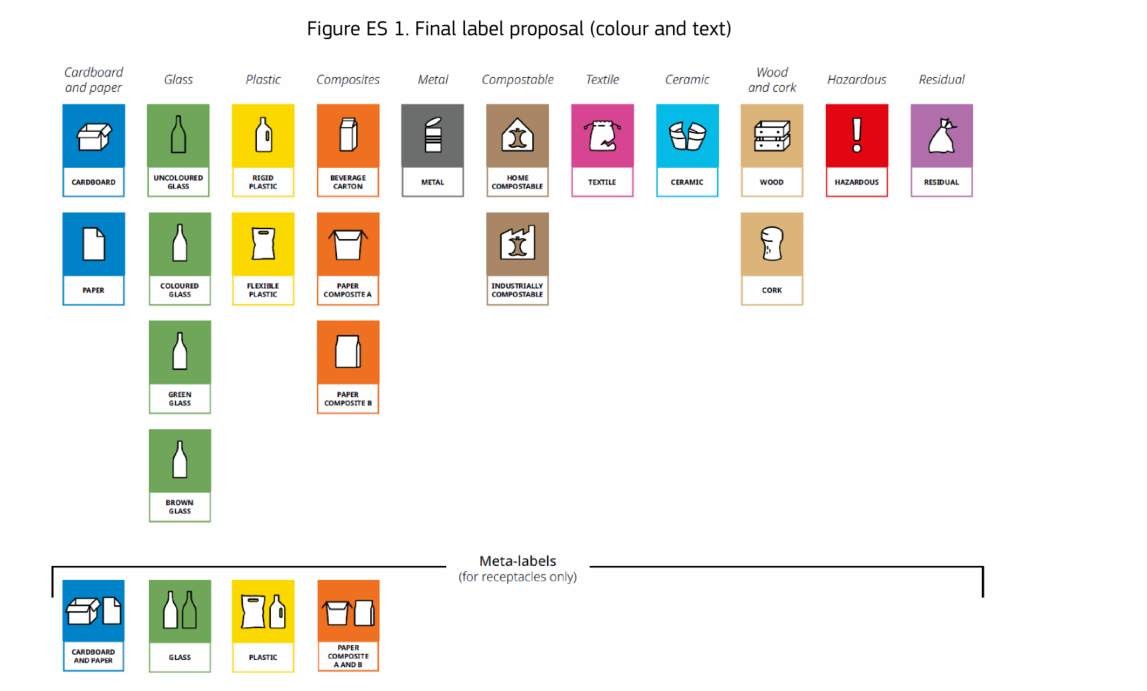
Source: Joint Research Centre (JRC) Technical Proposal on EU Harmonised Waste Sorting Labels under the Packaging and Packaging Waste Regulation (2026).
🧩 Multi-Component Packaging: A Major Compliance Challenge
Many packaging units are not made from one simple material. Examples include a cardboard sleeve around a plastic tray, a bottle with a plastic cap and paper label, a pouch made from several layers, a glass container with a pump, or a beverage carton made from fibre-based composite materials.
Multi-component packaging creates labeling challenges because different parts may need different sorting instructions. The proposed system allows multiple labels to appear on one packaging item where necessary, helping consumers understand whether components should be separated before disposal.
For businesses, this means packaging teams should map each component, identify its material, determine whether it is separable, check whether any part is composite, and assess whether country-specific sorting differences apply. Caps, pumps, sleeves, labels, liners and closures can affect the final label decision.
🧪 Composite Packaging: More Than One Material
Composite packaging is one of the more complex areas under the new labeling approach. It may include materials combined in layers or structures that consumers cannot easily separate, such as beverage cartons, laminated pouches, fibre-based composites, or packaging where paper, plastic, aluminium or other materials are combined.
The JRC proposal indicates that fibre-based composite packaging may require specific label categories, including beverage cartons and other fibre-based composite categories depending on fibre content. This means companies will need precise data, including material percentages, layer structures, supplier specifications and proof of whether a component meets a particular category.
Composite packaging also raises communication risks. A package may look like paper but contain plastic or aluminium layers. If the label suggests the wrong material stream, consumers may sort it incorrectly. Businesses should therefore review composite packaging early and avoid assumptions based on appearance.
🌱 Compostable Packaging: Clearer Warnings Are Expected
Compostable packaging is another priority area. The PPWR requires certain compostable packaging labels to clearly communicate whether the material is compostable, whether it is not suitable for home composting, and that it must not be thrown away in nature.
This is important because consumers may wrongly assume that “compostable” means packaging can be littered or will safely degrade in the natural environment. The new labeling approach is designed to prevent that misunderstanding.
Businesses placing compostable packaging on the EU market should prepare evidence showing whether the packaging is industrially compostable, home compostable, certified under relevant standards, and within the PPWR compostability scope. They should also review any environmental claims linked to compostability.
📲 QR Codes and Digital Information: Helpful, But Not a Replacement for Essential Labels
QR codes and other digital data carriers may play an important role under the PPWR labeling framework. They can provide detailed sorting instructions, component separation guidance, country-specific disposal rules, cleaning or emptying instructions, multilingual explanations and accessibility support.
However, digital tools should not be treated as a complete substitute for clear physical labels in most cases. Waste sorting is usually a quick action. Consumers may not scan a QR code every time they throw away packaging.
The best approach is likely to be:
Physical label for essential sorting information + QR code for additional details.
For businesses, digital labeling should be connected to controlled packaging data. QR code content should be accurate, maintained and aligned with the packaging sold in each market.
🧑🦯 Accessibility: Labels Must Work for More People
The PPWR also places emphasis on accessibility. Packaging labels should be easily understandable, including for persons with disabilities.
This can affect design decisions such as high contrast between icons and backgrounds, readable text size, simple pictograms, clear placement, avoidance of visual clutter and digital alternatives where physical labels are not sufficient. For receptacles, tactile elements or Braille may also be relevant where feasible.
🚫 Which Packaging May Be Exempt?
The PPWR provides exemptions from the harmonised waste sorting label requirement for certain packaging types.
|
Packaging Type |
Labeling Consideration |
|
🚚 Transport packaging |
Generally exempt, except e-commerce packaging. |
|
📦 E-commerce packaging |
Not covered by the general transport packaging exemption. |
|
🔁 Packaging under Deposit Return Systems |
May be exempt where the DRS label directs the consumer to the correct return route. |
|
♻️ Reusable packaging |
Subject to separate reusability labeling and digital information requirements. |
Companies should be careful with EU-wide packaging distributed across several Member States. A package may be covered by a Deposit Return System in one country but not another. In such cases, businesses may need to assess whether DRS information, harmonised sorting information or both are required.
📅 Key Timeline to Watch
|
Date / Period |
What Businesses Should Monitor |
|
2025 |
PPWR entered into force. |
|
12 August 2026 |
Implementing acts for harmonised labeling specifications are expected under the PPWR framework. |
|
12 August 2028 or later |
Existing national and regional waste sorting labels must be withdrawn from packaging by the applicable deadline. |
|
Transition period |
Packaging manufactured or imported before relevant deadlines may benefit from sell-through provisions. |
Do not wait until artwork deadlines become urgent. Packaging data, supplier documentation and label rules take time to build.
🧭 What Businesses Should Do Now
Companies placing packaging on the EU market should begin preparing before all technical details are finalized.
|
Action |
Why It Matters |
|
📦 Map all packaging units |
Identify every packaging item placed on the EU market. |
|
🧩 Break down components |
Separate caps, labels, sleeves, pumps, trays, cartons, closures and other parts. |
|
🧱 Classify materials |
Determine whether each component is paper, cardboard, plastic, glass, metal, wood, cork, textile, ceramic, compostable, composite, residual or hazardous. |
|
📊 Collect supplier evidence |
Request material composition data, weights, certificates and declarations. |
|
🌍 Check country scope |
Identify where each SKU is sold and whether local sorting or DRS rules affect labeling. |
|
🎨 Review artwork space |
Assess whether packaging can fit labels, text, QR codes and other markings. |
|
📲 Build digital readiness |
Connect QR codes or digital carriers to accurate, maintained packaging data. |
|
🧾 Prepare documentation |
Keep evidence supporting label decisions, classifications and exemptions. |
|
🔍 Review environmental claims |
Ensure claims such as “recyclable,” “compostable” or “recycled content” are supported. |
⚠️ Common Business Risks
The new labeling rules may create compliance risks if companies treat labels as a purely graphic design task. Common mistakes include using outdated national labels without checking transition deadlines, applying the same label to all packaging without material classification, ignoring small components, confusing home compostable and industrially compostable packaging, using QR codes without accurate data, missing DRS differences, and failing to document why a label or exemption was selected.
Packaging labeling under the PPWR will require coordination between regulatory compliance, sustainability, packaging engineering, procurement, marketing, design and supplier management teams.
💡 What This Means for Packaging Strategy
The PPWR labeling requirements are part of a broader shift in EU packaging compliance. Packaging is increasingly assessed based on material composition, recyclability, recycled content, reuse potential, waste sorting clarity, digital information availability, environmental claim accuracy and documentation.
Companies should therefore connect product data, supplier data, packaging specifications, artwork, market placement and regulatory obligations.
🚀 How ComplyMarket Can Support Your PPWR Labeling Compliance
ComplyMarket helps manufacturers, packaging suppliers, cosmetics brands, retailers, importers and global businesses prepare for the new EU Packaging Regulation requirements.
For the new packaging labeling requirements, ComplyMarket can support companies with:
- 🧭 PPWR applicability assessments to determine which packaging is in scope
- 📦 Packaging component mapping for single-material, multi-component and composite packaging
- 🧱 Material classification support for paper, cardboard, plastic, glass, metal, compostable, composite, textile, ceramic, cork, wood, residual and hazardous packaging categories
- 🎨 Labeling gap assessments against emerging PPWR labeling requirements
- 🌍 Country-specific compliance review for EU market placement, DRS differences and local sorting considerations
- 📲 Digital labeling and QR code strategy for supplementary sorting information and future digital compliance systems
- 🧾 Technical documentation preparation to support label decisions and compliance evidence
- 🔗 Supplier evidence management for packaging composition, recycled content, certifications and declarations
- ♻️ Environmental claims review to reduce the risk of misleading recyclability, compostability or sustainability statements
- 🧠 AI-powered packaging compliance workflows to centralize packaging data and automate compliance management
- ✅ Audit readiness support for future PPWR verification and enforcement expectations
With ComplyMarket’s Product, Sustainability and Material Compliance Management solutions, companies can centralize packaging data, manage supplier documentation, prepare labeling decisions and build a defensible compliance strategy for the EU Packaging Regulation.
✅ Final Takeaway
The EU Packaging Regulation introduces a major shift in how packaging labels communicate sorting information to consumers. The future system is expected to be more harmonised, visual, material-based and connected to waste receptacle labels across the EU.
For businesses, this is not just a design update. It is a compliance transformation involving packaging data, supplier evidence, artwork planning, digital information, accessibility and technical documentation.
Companies that prepare early will be better positioned to reduce redesign costs and avoid compliance gaps.

Comments
Leave a comment or ask a question
No comments yet.