Packaging Compliance Software for PPWR and EPR 2026
Packaging compliance is becoming too complex to manage through isolated spreadsheets, supplier emails, artwork folders, and separate national reporting portals.
The EU Packaging and Packaging Waste Regulation, known as the PPWR, introduces connected requirements covering packaging sustainability, recyclability, recycled content, labelling, technical documentation, minimization, reuse, refill, waste management, and producer responsibility.
Regulation (EU) 2025/40 entered into force on 11 February2025 and generally applies from 12 August 2026. However, many obligations follow their own phased timelines, making continuous requirement monitoring and change management essential.
The regulation is intended to prevent unnecessary packaging, improve recycling, increase recycled material use, and promote reuse and refill. These requirements affect the complete packaging life cycle rather than one isolated reporting activity.
At the same time, packaging Extended Producer Responsibility, or EPR, requires businesses to manage country-specific producer roles, registrations, material classifications, packaging weights, compliance schemes, reporting periods, fees, and supporting evidence.
For companies selling into several markets, the challenge is no longer simply understanding the law. It is maintaining accurate packaging records, applying requirements to the correct products, collecting reliable supplier evidence, meeting national reporting obligations, and proving compliance when requested.
Packaging compliance software can help turn these separate activities into one structured and repeatable process.
What Is Packaging Compliance Software?
Packaging compliance software is a digital system used to organize, assess, document, and monitor packaging obligations across products, suppliers, legal entities, and markets.
A suitable system can connect:
- Packaging items and components
- Products and SKUs
- Packaging materials and weights
- Suppliers and declarations
- Countries and legal entities
- PPWR requirements
- National EPR obligations
- Registration numbers
- Reporting periods
- Technical documentation
- Labels and packaging claims
- Compliance assessments
- Corrective actions
- Marketability decisions
The purpose is not simply to store documents. The purpose is to create a controlled link between the requirement, the packaging item, the evidence, the compliance decision, and the relevant market.
A basic document repository answers:
“Where is the supplier declaration?”
A packaging compliance platform should also help answer:
- Which packaging item does the declaration cover?
- Which supplier and material version does it relate to?
- Which products use that packaging?
- In which countries is it placed on the market?
- Which PPWR or EPR requirements apply?
- Is the evidence current and approved?
- Does the packaging have a compliance gap?
- Is a redesign or updated report required?
- Can the product continue to be sold in the target market?
This difference is critical. Packaging compliance requires connected data, not only stored files.
Why PPWR and EPR Require a New Compliance Model
Packaging compliance was often managed historically through local environmental reporting and packaging specifications.
The PPWR creates a broader operating model. Packaging decisions now affect regulatory compliance, supplier management, technical documentation, environmental claims, market access, packaging design, and digital information.
Official EU materials describe PPWR as covering sustainability and labelling requirements throughout packaging production, use, and waste management.
This creates several connected workflows:
|
Compliance Area |
Data and Evidence Needed |
|
Material composition |
Packaging components, materials, weights, coatings, inks and adhesives |
|
Substance requirements |
Supplier declarations, test reports and material evidence |
|
Recyclability |
Design assessments, component compatibility and recyclability evidence |
|
Recycled content |
Percentage, material source, supplier proof and calculation method |
|
Labelling |
Artwork, material information, claims, QR codes and country requirements |
|
Technical documentation |
Specifications, drawings, standards, tests and conformity records |
|
Minimization |
Dimensions, weights, empty-space calculations and technical justification |
|
Reuse and refill |
System information, rotations, collection, cleaning and consumer instructions |
|
Packaging EPR |
Producer role, registration, material weights, reporting and fee data |
|
Deposit return systems |
Packaging scope, labels, deposits, units placed and returned |
|
Online marketplace sales |
Registration numbers, seller evidence and self-certification |
A separate spreadsheet for each topic creates duplicate data and inconsistent conclusions. A packaging component should ideally be entered once and then reused across relevant assessments and reports.
Why Manual Packaging Compliance Becomes Difficult at Scale
Spreadsheets can be useful during an initial assessment. They become harder to control when packaging portfolios, suppliers, countries, and reporting requirements increase.
Common limitations of manual processes
|
Manual Process Problem |
Compliance Consequence |
|
Different teams maintain separate files |
Packaging data becomes inconsistent |
|
Supplier evidence is stored in emails |
Documents are difficult to locate or validate |
|
Packaging weights are entered repeatedly |
EPR reports may contain conflicting figures |
|
Requirements are tracked manually |
Regulatory changes may be missed |
|
No controlled packaging version |
Evidence may relate to an obsolete design |
|
Country reports use different classifications |
Reporting becomes difficult to reconcile |
|
Approvals occur through email |
Audit history is incomplete |
|
Claims are approved separately from evidence |
Artwork may contain unsupported information |
|
Deadlines depend on individual calendars |
Registrations or reports may be missed |
|
No central ownership |
Teams are unsure who must correct a gap |
The risk is not only inefficiency. Fragmented information can result in incorrect producer registrations, inaccurate packaging reports, unsupported claims, obsolete technical files, and delayed product launches.
Manual Management vs Compliance Automation
|
Activity |
Manual Approach |
Automated or Structured Approach |
|
Requirement monitoring |
Teams search for updates individually |
Central requirements library with assigned review |
|
Applicability |
Legal text interpreted separately for each project |
Rules mapped to products, packaging and markets |
|
Packaging inventory |
Separate local spreadsheets |
Controlled packaging master data |
|
Supplier collection |
Email requests and reminders |
Structured questionnaires and tracked requests |
|
Evidence review |
Files checked individually |
Approval status, expiry and gap tracking |
|
EPR calculations |
Manual consolidation |
Reusable calculation and validation rules |
|
Country reporting |
Data reformatted for every submission |
Reporting views generated from controlled data |
|
Technical files |
Folders assembled when requested |
Continuously maintained evidence structure |
|
Artwork approval |
Marketing and compliance work separately |
Claims and labels linked to supporting evidence |
|
Change control |
Updates depend on individual awareness |
Triggered reassessment after relevant changes |
|
Audit response |
Teams search across systems |
Searchable record with decisions and history |
Automation should reduce repeated administrative work. It should not remove the need for professional compliance judgment.
What Packaging Compliance Software Should Manage
A packaging compliance platform should cover several connected data and workflow areas.
1. Packaging Inventory and Packaging Bill of Materials
The foundation is a complete packaging inventory.
Every packaging item should have a controlled identity, including primary or sales packaging, grouped packaging, transport packaging, e-commerce packaging, service packaging, reusable packaging, refill packaging, and packaging components.
Recommended packaging master data
|
Data Category |
Example Fields |
|
Packaging identification |
Packaging ID, name, version and status |
|
Product relationship |
Product, SKU, product family and brand |
|
Packaging level |
Sales, grouped, transport, e-commerce or service |
|
Component structure |
Bottle, cap, box, label, adhesive, coating, tray or film |
|
Material |
Plastic, paper, cardboard, glass, metal, wood or composite |
|
Weight |
Component weight and total packaging weight |
|
Dimensions |
Length, width, height, volume and capacity |
|
Supplier |
Supplier, production site and contact |
|
Markets |
Countries where the packaging is used |
|
Evidence |
Declaration, specification, test report or certificate |
|
Compliance status |
Compliant, gap identified, under review or not assessed |
|
Effective dates |
Introduction, replacement and retirement dates |
A packaging bill of materials helps connect the complete packaging unit to each component. This is important because recyclability, chemical restrictions, recycled content, labelling, and reporting may depend on component-level information.
2. Requirement and Applicability Management
A company may track hundreds of packaging requirements across the EU and national markets.
Software can support this by linking requirements to:
- Packaging materials
- Packaging categories
- Product types
- Business roles
- Legal entities
- Countries
- Sales channels
- Application dates
- Reporting periods
- Exemptions
- Evidence requirements
Automation can then identify which packaging items require assessment.
For example, the system may distinguish between:
- Plastic and non-plastic packaging
- Single-use and reusable packaging
- Food-contact and non-food-contact packaging
- Beverage packaging and other packaging
- Sales and transport packaging
- Packaging sold online and packaging placed through traditional distribution
- Packaging placed on one market and packaging used across multiple Member States
This does not mean the system should make unsupported legal conclusions automatically. It should help compliance professionals apply consistent decision rules and document the reason for each outcome.
3. Supplier Data and Evidence Collection
Packaging compliance depends heavily on supplier information.
Suppliers may need to provide:
- Material composition
- Component weights
- Heavy-metal declarations
- PFAS information where relevant
- Recycled content data
- Recyclability assessments
- Food-contact declarations
- Compostability evidence
- Test reports
- Certifications
- Technical drawings
- Manufacturing site information
- Change notifications
A structured platform can standardize supplier requests and show which information is missing.
Useful supplier workflow statuses
- Request not sent
- Request sent
- Supplier response received
- Evidence incomplete
- Under technical review
- Approved
- Rejected
- Expired
- Replacement evidence required
The system should also link supplier evidence to the exact packaging code, material, component, supplier, site, and version it covers.
A generic supplier declaration is not enough when the business cannot show which packaging it supports.
4. Evidence and Document Management
Packaging compliance documentation can include:
- Packaging specifications
- Drawings and technical descriptions
- Supplier declarations
- Laboratory reports
- Standards and assessment methods
- Recyclability evidence
- Recycled content calculations
- Compostability certificates
- Empty-space calculations
- Reuse system documents
- Artwork files
- QR-code records
- EPR registration confirmations
- Producer responsibility organization agreements
- Appointed representative mandates
- Reporting submissions
- EU Declarations of Conformity
Software can help manage document ownership, approval, expiry dates, versions, and links to affected packaging.
Document-control features that add practical value
|
Feature |
Compliance Benefit |
|
Version history |
Shows which evidence applied at a particular time |
|
Approval workflow |
Prevents unreviewed documents being treated as valid |
|
Expiry alerts |
Identifies evidence requiring renewal |
|
Packaging link |
Shows exactly what the document covers |
|
Supplier link |
Identifies the source of the information |
|
Market link |
Shows where the evidence is being relied upon |
|
Change log |
Records who changed the record and why |
|
Controlled access |
Protects confidential supplier information |
|
Audit export |
Supports customer and authority requests |
5. Technical Documentation Automation
PPWR technical documentation requires structured evidence rather than a collection of unrelated files.
A packaging compliance platform can help create a technical-file structure containing:
- General packaging description
- Intended use
- Packaging and component drawings
- Material composition
- Manufacturing information
- Applicable requirements
- Standards and specifications
- Substance evidence
- Recyclability assessment
- Recycled content evidence
- Minimization evidence
- Reuse or refill documentation
- Labelling information
- Conformity conclusion
- Declaration records
- Change history
The official PPWR framework requires conformity assessment and supporting technical documentation for applicable packaging requirements.
Automation can populate repeated fields from approved master data, reducing duplicate entry. The compliance professional should still review the technical conclusion and approve the final file.
6. Recyclability Workflow Management
PPWR recyclability requirements require companies to assess complete packaging units, not only the main material.
Software can help track:
- Design-for-recycling status
- Main packaging material
- Component compatibility
- Labels and sleeves
- Adhesives
- Closures
- Coatings and barriers
- Pigments and inks
- Sorting compatibility
- Recycling stream
- Assessment method
- Performance grade
- Supporting evidence
- Redesign status
- Future recyclability-at-scale evidence
The PPWR aims to make packaging recyclable and introduces phased requirements covering design for recycling and recycling at scale.
A useful workflow should identify packaging that:
- Has not been assessed
- Has incomplete component data
- Depends on expired evidence
- Requires redesign before a future milestone
- Has conflicting supplier and internal conclusions
- Is used in markets with different collection realities
7. Recycled Content Management
For plastic packaging, software can help classify packaging and track the recycled content evidence needed for applicable requirements.
Recommended recycled content data
|
Data Field |
Purpose |
|
Plastic type |
Supports packaging classification |
|
Contact-sensitive status |
Helps identify the relevant category |
|
Beverage bottle status |
Supports specific requirement mapping |
|
Recycled content percentage |
Records the declared content |
|
Post-consumer source |
Supports evidence review |
|
Supplier declaration |
Provides traceability |
|
Calculation method |
Documents how the percentage was determined |
|
Verification record |
Supports review and audit |
|
Applicable exemption |
Records the legal basis where used |
|
Target gap |
Shows difference between current and required content |
Automation can show which packaging items have incomplete evidence or are below a future target. It should not assume that every supplier percentage is automatically acceptable.
8. Labelling, Claims and Artwork Control
Packaging labels are regulated information and should be controlled accordingly.
A system can connect artwork and claims to:
- Material composition
- Sorting instructions
- Reusability status
- Recycled content
- Compostability
- Biobased content
- Deposit-return participation
- Manufacturer or importer information
- QR-code content
- Country-specific requirements
Example automated controls
- Prevent final approval when required evidence is missing
- Alert when artwork uses an obsolete packaging version
- Identify claims without supporting documents
- Require review after a material or supplier change
- Link QR-code destinations to packaging versions
- Track which artwork is used in each market
- Flag inconsistent manufacturer information
This reduces the risk that packaging data is correct internally while the printed packaging remains inaccurate.
9. Packaging Minimization and Empty-Space Calculations
Packaging minimization can be supported through controlled dimensions, product measurements, packaging weights, and empty-space calculations.
Software can store:
- Product dimensions
- Sales packaging dimensions
- Outer shipping packaging dimensions
- Packaging volume
- Product or inner packaging volume
- Empty-space ratio
- Filler material
- Filler volume
- Protection testing
- Technical justification
- Alternative designs considered
Automated calculation rules can identify packaging exceeding a defined threshold or requiring review.
The compliance decision still needs human validation because additional packaging may be justified by safety, hygiene, fragility, legal information, or transport performance.
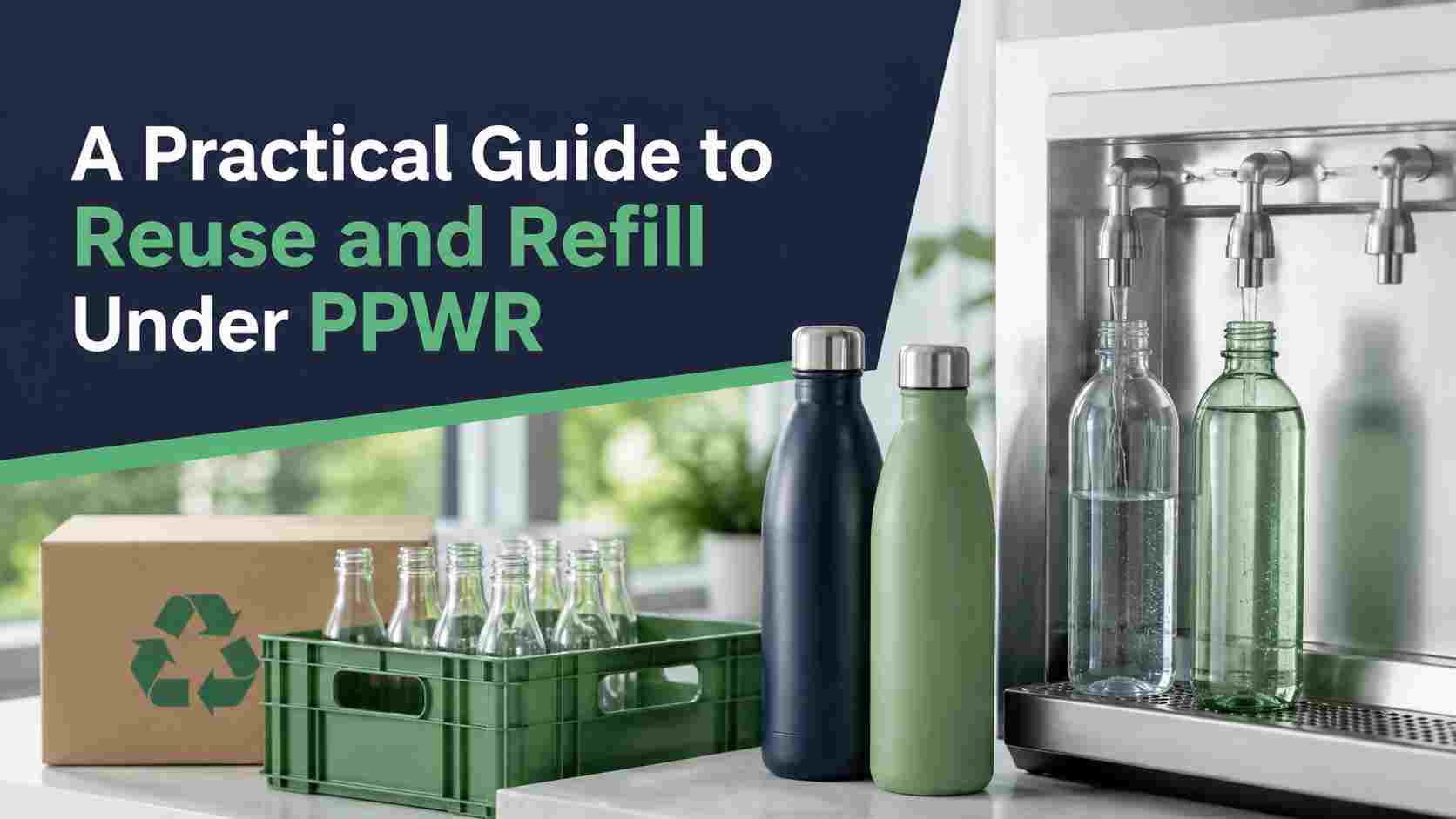
10. Reuse and Refill Data Management
Reusable packaging and refill systems require operational data, not only design information.
A system can track:
- Reusable packaging status
- Reuse system type
- System operator
- Participants
- Units placed on the market
- Units in circulation
- Trips or rotations
- Collection points
- Return rates
- Cleaning and reconditioning records
- Damaged or retired units
- Consumer instructions
- Refill-station information
- Applicable targets
- Exemptions and supporting evidence
This makes it easier to distinguish a genuine reuse system from packaging that is merely capable of informal reuse.
11. Packaging EPR Registration Management
Packaging EPR obligations vary by jurisdiction. A company may need separate registrations, compliance schemes, representatives, reporting calendars, and evidence for several markets.
ComplyMarket describes EPR management as requiring regulatory intelligence, applicability control, data collection, reporting, evidence management, and jurisdiction-level oversight.
EPR registration data software should manage
|
Data Category |
Example |
|
Country |
Member State or other jurisdiction |
|
Responsible legal entity |
Producer, importer, retailer or distance seller |
|
Producer role |
Role under the relevant national framework |
|
Registration number |
National producer identifier |
|
Registration status |
Planned, submitted, active, rejected or expired |
|
Compliance scheme |
PRO or other scheme |
|
Representative |
Appointed or authorised representative |
|
Reporting frequency |
Monthly, quarterly, half-yearly or annual |
|
Reporting deadline |
Submission due date |
|
Fee structure |
Material or weight-related fees |
|
Supporting evidence |
Registration confirmation, contract or payment record |
Automated alerts can support renewals, reporting deadlines, data requests, and evidence updates.
12. EPR Reporting and Calculation Automation
EPR reporting commonly depends on:
- Packaging material
- Packaging type
- Weight
- Units placed on the market
- Country
- Reporting period
- Product category
- Household or non-household classification
- Reusable status
- Deposit-return status
- Imported and exported quantities
- National exceptions
Software can consolidate approved packaging data with sales or market-placement information.
Automated reporting workflow
1- Identify products sold in the reporting market.
2- Link each product to its approved packaging structure.
3- Apply the packaging weight per unit.
4- Multiply by the quantity placed on the market.
5- Apply material and category classifications.
6- Apply approved exclusions or adjustments.
7- Validate missing or unusual values.
8- Produce the jurisdiction-specific reporting dataset.
9- Route the report for internal approval.
10- Store the submitted version and evidence.
Automation improves repeatability. It does not remove the need to verify national definitions, reporting boundaries, and calculation rules.
13. Deposit Return System Data
Where deposit-return systems apply, software can help manage:
- Packaging scope
- Packaging capacity
- Material
- National system operator
- Registration details
- Deposit value
- Label or barcode
- Units placed on the market
- Units returned
- Refund data
- Reporting records
- Effective dates
- Artwork transition
This data should align with EPR reporting to prevent the same packaging being classified differently across systems.
14. Online Marketplace and Seller Evidence
Online sellers may need packaging EPR registration information, self-certification, and supporting records for marketplaces or fulfilment providers.
Software can create a controlled evidence pack containing:
- Producer registration number
- Country coverage
- Registration confirmation
- PRO participation
- Representative mandate
- Self-certification
- Packaging material and weight data
- Reporting records
- Fee evidence
- Product-to-market mapping
The benefit is faster response when a marketplace asks for evidence and lower risk of providing an outdated registration number.
15. Alerts, Tasks and Regulatory Change Management
Packaging compliance obligations continue to evolve through implementing acts, delegated acts, official guidance, national legislation, and scheme updates.
The European Commission published updated PPWR guidance and FAQs in 2026, illustrating why businesses need a continuing monitoring process rather than a one-time assessment.
Useful automated alerts include:
- Regulatory update requires review
- New requirement applies to a market
- Reporting deadline approaching
- Supplier evidence missing
- Declaration expiring
- Packaging redesign assessment overdue
- Registration renewal due
- Artwork uses outdated data
- Recycled content target gap identified
- Recyclability evidence incomplete
- Packaging volume changed significantly
- Supplier notified a material change
Each alert should have an assigned owner, deadline, status, and escalation route.
16. Workflow, Approval and Audit Trail
Compliance automation should support controlled decisions.
Example approval workflow
|
Stage |
Responsible Function |
|
Packaging data entry |
Packaging engineering or supplier |
|
Material review |
Material or product compliance |
|
Supplier evidence review |
Procurement, quality or compliance |
|
Requirement assessment |
Regulatory or compliance team |
|
Artwork review |
Regulatory, legal and marketing |
|
EPR classification |
Environmental or EPR team |
|
Marketability approval |
Authorised compliance owner |
|
Change release |
Packaging change-control team |
The system should record:
- Who submitted the data
- Who reviewed it
- What evidence was considered
- Which requirement was applied
- What decision was made
- When the approval occurred
- What changed later
- Whether reassessment was completed
This provides a defensible audit trail.
Automation Does Not Replace Compliance Expertise
Packaging compliance software should support professional judgment, not replace it.
Human review remains essential for:
- Interpreting unclear or evolving requirements
- Determining the responsible producer
- Assessing exemptions
- Reviewing supplier evidence quality
- Deciding whether testing is necessary
- Evaluating technical justifications
- Approving environmental claims
- Assessing marketability
- Responding to authorities
- Managing corrective actions
Automation is most effective when the decision logic is clear and repeatable.
Suitable activities for automation
- Data validation
- Missing-field checks
- Deadline reminders
- Document expiry alerts
- Repeated calculations
- Report preparation
- Workflow routing
- Version comparison
- Status dashboards
- Evidence-pack generation
Activities requiring expert review
- Legal interpretation
- Exception assessment
- Technical evidence evaluation
- Regulatory strategy
- Risk acceptance
- Final conformity decision
- Authority communication
A system should make expert review easier and more consistent, not hide it behind an unexplained automated result.
How Packaging Compliance Software Supports Different Teams
|
Team |
Practical Benefit |
|
Regulatory affairs |
Central requirements and applicability decisions |
|
Product compliance |
Evidence, assessments and marketability status |
|
Packaging engineering |
Controlled packaging specifications and redesign priorities |
|
Procurement |
Supplier requests, evidence gaps and change notifications |
|
Sustainability |
Recycled content, recyclability, reuse and circularity data |
|
Quality |
Approved specifications, tests and supplier records |
|
Logistics |
Transport and e-commerce packaging data |
|
E-commerce |
Marketplace evidence and fulfilment packaging information |
|
Finance |
EPR fees, deposit data and cost visibility |
|
Legal |
Claims, responsibility allocation and risk review |
|
Management |
Portfolio dashboards, deadlines and unresolved risks |
A shared platform reduces the risk that every department creates a different version of packaging compliance data.
Integrating Packaging Compliance with Existing Systems
Packaging compliance software does not need to replace every existing business system.
It can connect with:
- Product lifecycle management systems
- Enterprise resource planning systems
- Supplier portals
- Document management systems
- Product information management systems
- Artwork management platforms
- Sales data systems
- E-commerce systems
- Laboratory or testing databases
- Sustainability reporting tools
Typical integration model
|
Source System |
Data Used for Compliance |
|
ERP |
Products, legal entities, sales quantities and suppliers |
|
PLM |
Packaging specifications, materials and revisions |
|
PIM |
Product and market information |
|
Supplier portal |
Declarations, tests and evidence |
|
Artwork system |
Labels, claims and artwork versions |
|
Sales system |
Units placed on the market |
|
Compliance platform |
Requirements, assessments, evidence and reporting |
|
EPR portal |
Final national submission |
The compliance platform should act as the controlled layer connecting regulatory rules to business data and evidence.
How to Select Packaging Compliance Software
Companies should evaluate more than the appearance of the dashboard.
Essential selection criteria
|
Selection Area |
Questions to Ask |
|
Regulatory coverage |
Can the platform manage EU and country-specific packaging obligations? |
|
Packaging data model |
Can it manage packaging levels, components, materials and versions? |
|
Supplier collaboration |
Can suppliers submit evidence through a controlled process? |
|
Requirement mapping |
Can rules be connected to packaging and markets? |
|
EPR support |
Can it manage registrations, roles, reports and evidence by country? |
|
Technical documentation |
Can it organize packaging technical files and declarations? |
|
Workflow |
Can reviews and approvals be assigned and tracked? |
|
Change control |
Can a packaging change trigger reassessment? |
|
Reporting |
Can controlled datasets be exported for national submissions? |
|
Audit trail |
Are decisions and data changes traceable? |
|
Integration |
Can the platform connect with existing product and sales systems? |
|
Access control |
Can confidential data be restricted by role? |
|
Scalability |
Can it support many SKUs, suppliers and markets? |
|
Implementation support |
Is expert support available for data structure and workflows? |
A system should support the company’s actual operating model, not force every compliance question into one generic checklist.
Packaging Compliance Software Implementation Roadmap
Step 1: Define the compliance scope
Identify:
- Packaging categories
- Products and brands
- Suppliers
- Legal entities
- Countries
- EPR schemes
- Reporting obligations
- PPWR topics
- Business teams
Start with high-risk or high-volume packaging rather than attempting to migrate everything without prioritization.
Step 2: Build the packaging data model
Define standard fields for:
- Packaging IDs
- Packaging levels
- Materials
- Components
- Weights
- Dimensions
- Suppliers
- Countries
- Evidence
- Versions
- Compliance statuses
Step 3: Clean existing data
Remove duplicates, identify missing weights, standardize material categories, and confirm which packaging versions are active.
Step 4: Assign data owners
Define who owns product data, packaging data, supplier evidence, EPR records, artwork, reporting, and final approvals.
Step 5: Configure requirement mapping
Connect requirements to packaging types, materials, countries, company roles, and application dates.
Step 6: Create supplier workflows
Prepare standardized questionnaires, evidence requirements, approval criteria, and escalation steps.
Step 7: Configure EPR workflows
Set up country registrations, reporting periods, calculation rules, review steps, and submission records.
Step 8: Connect technical documentation
Build reusable technical-file templates linked to packaging master data and evidence.
Step 9: Pilot the process
Test the workflow with a selected product family, supplier group, or country before full deployment.
Step 10: Expand and continuously improve
Add further products, markets, integrations, reports, and controls based on pilot results.
Packaging Compliance Automation Checklist
|
Question |
Status |
|
Is every packaging item included in a controlled inventory? |
To be checked |
|
Is packaging linked to products and countries? |
To be checked |
|
Are materials and component weights available? |
To be checked |
|
Is there one controlled packaging version? |
To be checked |
|
Are applicable requirements mapped automatically or systematically? |
To be checked |
|
Can suppliers submit evidence through a structured workflow? |
To be checked |
|
Are evidence gaps and expiry dates visible? |
To be checked |
|
Can technical files be generated from approved data? |
To be checked |
|
Are labels and claims linked to supporting evidence? |
To be checked |
|
Are recyclability and recycled content gaps tracked? |
To be checked |
|
Are minimization calculations controlled? |
To be checked |
|
Are reuse and refill records available where relevant? |
To be checked |
|
Are EPR registrations managed by country? |
To be checked |
|
Can EPR reports be generated from controlled data? |
To be checked |
|
Are DRS records aligned with packaging data? |
To be checked |
|
Are marketplace evidence packs available? |
To be checked |
|
Are deadlines and regulatory updates assigned to owners? |
To be checked |
|
Is there a complete audit trail? |
To be checked |
|
Can packaging changes trigger reassessment? |
To be checked |
|
Are unresolved compliance risks visible to management? |
To be checked |
Useful Packaging Compliance Performance Indicators
Companies can use measurable indicators to assess whether their compliance system is improving.
Suggested operational indicators
|
Indicator |
What It Shows |
|
Percentage of packaging with complete material data |
Packaging master-data quality |
|
Percentage with verified component weights |
EPR reporting readiness |
|
Percentage with current supplier declarations |
Evidence readiness |
|
Percentage with approved technical files |
Conformity readiness |
|
Packaging items with unresolved compliance gaps |
Portfolio risk |
|
Supplier requests overdue |
Supply-chain responsiveness |
|
Registrations expiring within 90 days |
EPR continuity risk |
|
Reports submitted on time |
EPR operational performance |
|
Artwork claims without evidence |
Labelling risk |
|
Packaging changes awaiting reassessment |
Change-control risk |
|
High-risk packaging requiring redesign |
Future PPWR readiness |
|
Average time to produce an evidence pack |
Audit-response capability |
Metrics should support action, not become reporting for its own sake.
Common Automation Mistakes to Avoid
1. Automating poor-quality data
Software cannot correct inaccurate packaging weights or unsupported supplier claims by itself.
2. Treating the platform as a file archive
Documents should be connected to packaging, requirements, suppliers, and decisions.
3. Building workflows without clear ownership
Every task and data field needs a responsible person or function.
4. Automating legal conclusions without review
Rules can support consistency, but expert approval is still required.
5. Ignoring packaging versions
Evidence and assessments must relate to the packaging currently placed on the market.
6. Separating EPR from packaging design data
EPR reports and PPWR assessments should use the same controlled packaging records.
7. Migrating every spreadsheet without cleaning it
Duplicate and inconsistent data should be corrected before migration.
8. Focusing only on current deadlines
The system should support future milestones, redesign planning, and regulatory changes.
9. Excluding suppliers from the workflow
Supplier evidence is central to packaging compliance.
10. Failing to document automated logic
Calculation rules and automated classifications should be transparent and reviewable.
How ComplyMarket Supports Packaging Compliance Automation
ComplyMarket describes packaging compliance as a market-access process involving packaging materials, restricted substances, labelling, recycling, documentation, registration, reporting, EPR, supplier evidence, and country-specific requirements.
Its product compliance management approach includes centralized regulatory information, evidence management, marketability monitoring, alerts, and collaboration with suppliers and internal teams.
ComplyMarket’s EPR management approach also focuses on regulatory intelligence, applicability control, data collection, reporting, evidence management, and scalable audit readiness.
ComplyMarket can support packaging compliance processes by helping companies manage:
- Packaging inventories and component data
- Product-to-packaging relationships
- Country-specific packaging requirements
- Supplier declarations and evidence
- Regulatory applicability assessments
- Packaging technical documentation
- Recyclability and recycled content records
- Packaging labels, claims, and QR-code evidence
- EPR registrations and reporting data
- Producer responsibility organization records
- Representative and mandate information
- Deposit-return data
- Reuse and refill information
- Documentation versions and approvals
- Compliance alerts and open actions
- Audit-ready reports and evidence packs
ComplyMarket also presents product compliance, material compliance, packaging compliance, EPR, Digital Product Passport, and global market access as connected compliance areas within its broader solution approach.
The practical value is the ability to connect packaging requirements with the packaging item, supplier evidence, target country, responsible team, compliance status, and supporting records.
For companies managing many SKUs, suppliers, and jurisdictions, this can reduce dependency on disconnected spreadsheets and make packaging compliance more traceable and repeatable.
Comments
Leave a comment or ask a question
No comments yet.